The Right-Angled Unit Cell of the Hexagonal Lattice
The conventional unit cell of the hexagonal lattice consists of two equal-length \(a\) axes and a \(c\) axis. The angle \(\beta\) is \(120^{\circ}\). This can be seen below.
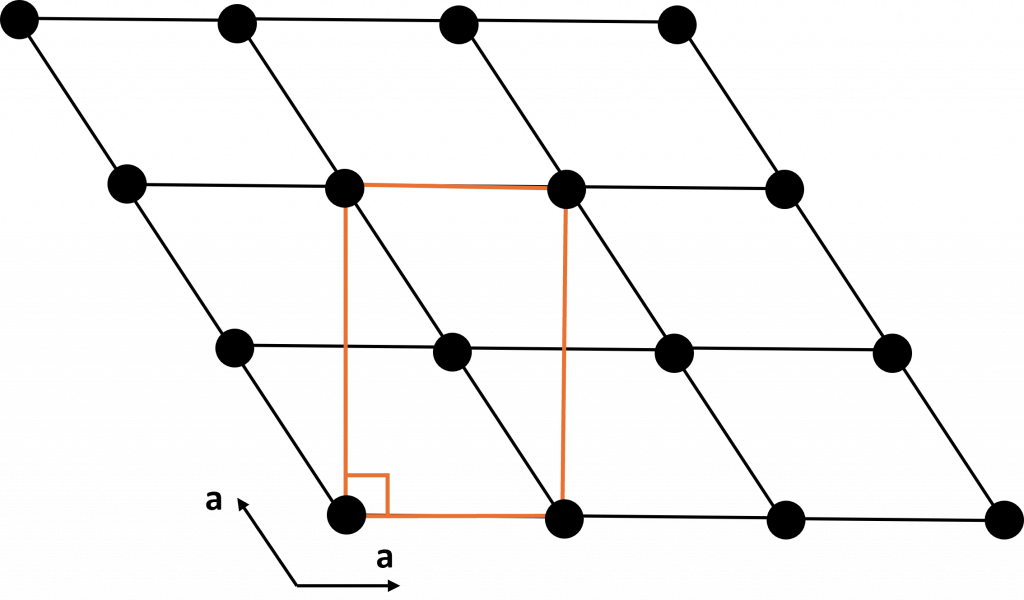
Therefore, there exists a unit cell representing the lattice which is a cuboid shape i.e. has all angles equal to \(90^{\circ}\). The presence of this unit cell explains why hexagonal space groups can have mirror planes present that do not point along or perpendicular to the axes of the conventional unit cell.
The new unit cell vectors are as follows: $$\mathbf{a’} = 2\mathbf{a} + \mathbf{b}$$ $$\mathbf{b}’ = \mathbf{b}$$ $$\mathbf{c’} = \mathbf{c}$$ It is relatively simple to use trigonometry to show that the length of \(a’\) is equal to \(2a \times \sin(30^{\circ})\). Therefore: $$|\mathbf{a’}| = |\mathbf{a}| \sqrt{3}$$
This new cell appears equivalent to the base-centred orthorhombic lattice but it is distinct by the symmetry it possesses. In the same way that any lattice discussed on this site is a special case of the triclinic lattice, the hexagonal lattice is a special case of the base-centred orthorhombic lattice where \(|\mathbf{a}| = |\mathbf{b}| \sqrt{3}\).